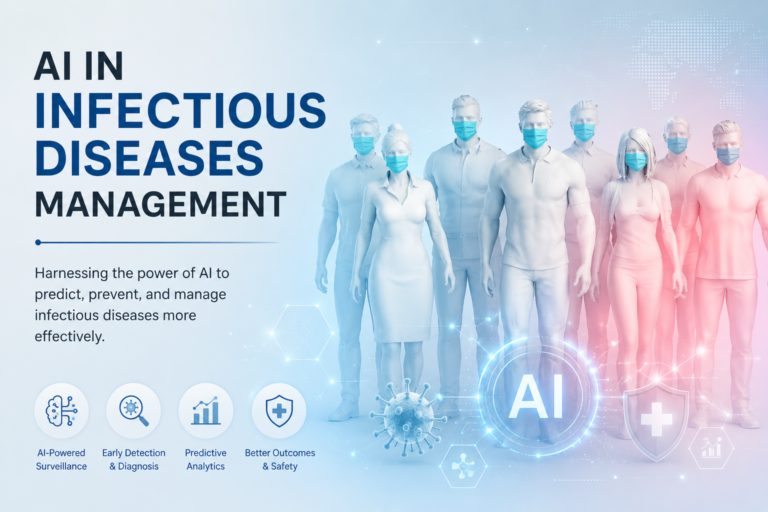
Artificial Intelligence (AI) has emerged as one of the most transformative technologies of the 21st century.
From predicting consumer behavior to detecting financial fraud, its applications are broad and impactful.
In healthcare, and particularly in the realm of infectious diseases, AI holds immense promise.
With growing challenges such as antimicrobial resistance, emerging pandemics, and the complexity of patient management, AI-powered tools can help clinicians handle data, make quicker decisions, and improve outcomes.
Yet, while the technology is impressive, it is not flawless.
Over-reliance on AI can lead to dangerous oversights, and it is essential to remember that clinical judgment, empathy, and contextual expertise of doctors remain irreplaceable.
This blog explores how AI is being used in infectious diseases, the pitfalls we must guard against, and why the human doctor will always remain central to patient care.
How AI is Transforming Infectious Disease Management
1. Early Detection and Surveillance
AI algorithms can analyze vast streams of data from hospitals, laboratories, social media, and even search engines to detect unusual trends in infections.
During outbreaks such as COVID-19, AI-driven systems flagged early warnings about rising clusters of pneumonia cases in China before official alerts were issued.
For diseases like dengue, malaria, or influenza, AI models help forecast outbreaks by integrating climate data, population density, and mobility patterns.
This empowers governments and hospitals to mobilize resources proactively.
2. Rapid Diagnostics
Traditional diagnostic tests often take hours to days. AI has accelerated this timeline by analyzing imaging, laboratory reports, and genomic sequencing data within minutes.
For example:
– Machine learning tools can identify tuberculosis from chest X-rays with accuracy comparable to radiologists.
– AI-driven genomic platforms can rapidly interpret metagenomic next-generation sequencing (mNGS) data to pinpoint rare pathogens.
– This speed is invaluable in critically ill patients where time determines survival.
3. Optimizing Antimicrobial Therapy
The rise of antimicrobial resistance (AMR) is one of the greatest global health threats. AI can support antimicrobial stewardship by:
– Suggesting the most likely pathogens based on patient history, local antibiograms, and clinical data.
– Predicting resistance patterns and guiding antibiotic choice.
– Adjusting dosages using pharmacokinetic and pharmacodynamic modeling.
– Such systems reduce inappropriate antibiotic use, thereby preserving the effectiveness of existing drugs.
4. Clinical Decision Support Systems (CDSS)
AI-powered CDSS tools integrate patient records, laboratory results, and guidelines to suggest tailored treatment pathways.
For example, an AI system may recommend switching from intravenous to oral therapy when a patient meets stability criteria— something already studied in the OVIVA trial for bone and joint infections.
This not only improves patient outcomes but also reduces hospital stays and healthcare costs.
5. Research and Drug Development
AI is accelerating the discovery of new antimicrobials and vaccines.
By simulating molecular interactions, AI can screen millions of compounds far faster than traditional laboratory research.
The recent development of mRNA vaccines also relied heavily on bioinformatics and AI modeling.
The Pitfalls of AI In Infectious Disease Management
Despite its benefits, AI is not a silver bullet. Several pitfalls need attention:
1. Data Quality and Bias
AI is only as good as the data it learns from.
If the training data is incomplete, biased, or outdated, the algorithm will produce misleading results.
For instance, an AI trained on data from Western populations may misclassify infections in Indian patients due to genetic, environmental, or healthcare differences.
2. Over-Reliance and Deskilling
There is a risk that doctors may become overly dependent on AI recommendations, leading to erosion of critical thinking skills.
Medicine is an art as much as it is a science; not every patient fits into an algorithm. For example, a septic patient with multiple comorbidities may require nuanced decision-making beyond what AI can suggest.
3. Black-Box Problem
Many AI models, particularly deep learning systems, are “black boxes”—their decision making process is not transparent.
This lack of explainability makes it hard for clinicians to trust the output fully, especially when life-saving decisions are at stake.
4. Ethical and Legal Issues
Who is responsible if an AI-driven diagnosis or treatment recommendation harms a patient—the software developer, the hospital, or the treating doctor? This lack of clear legal frameworks creates significant ethical dilemmas.
5. Resource Inequity
AI tools are expensive and often available only in resource-rich hospitals.
In low- and middle-income countries, where infectious diseases are most prevalent, the digital divide could worsen healthcare inequities if
AI becomes the sole focus.
Why Doctors’ Skills and Expertise Remain Irreplaceable
While AI is a powerful assistant, it can never replace the human doctor. Here’s why:
1. Contextual Understanding
AI analyzes data but cannot grasp the human context. For instance, it cannot appreciate a patient’s financial limitations, cultural beliefs, or psychological fears—factors that often dictate treatment choices.
2. Clinical Nuance
Infectious diseases are notoriously complex. Two patients with the same infection can respond very differently due to comorbidities, immune status, or drug interactions.
Doctors bring years of training and intuition to tailor therapy accordingly.
3. Compassion and Communication
Healing is not just about prescribing antibiotics—it is also about holding a patient’s hand, answering their fears, and giving them hope. No algorithm can replicate human empathy and the therapeutic doctor–patient relationship.
4. Ethical Judgment
Doctors make difficult calls every day: whether to initiate costly treatment, when to shift to palliative care, or how to balance patient autonomy with public health safety.
These judgments require ethical reasoning that AI cannot mimic.
5. Guardians Against Misuse
Ultimately, doctors serve as the check against AI errors. They validate machine outputs, challenge questionable recommendations, and ensure patient safety remains paramount.
The Way Forward: Partnership, Not Replacement
The future lies not in choosing between AI or doctors but in forging a partnership.
AI can handle the heavy lifting of data analysis, while doctors focus on clinical reasoning, ethical decision-making, and patient care.
To achieve this balance:
– Doctors must stay digitally literate to understand and critique AI tools.
– AI systems must become explainable and transparent, so clinicians can trust their recommendations.
– Regulatory frameworks must evolve to ensure accountability and ethical use.
– Patients must be educated that AI is an adjunct, not a replacement, for their physician.
Conclusion:
AI is revolutionizing infectious disease management—from predicting outbreaks to personalizing treatment and accelerating drug discovery.
Its potential to improve global health is undeniable. Yet, it comes with pitfalls such as bias, over-reliance, and ethical ambiguity.
The role of the doctor remains central—bringing context, compassion, and clinical wisdom that no algorithm can replicate.
In the end, the best outcomes will emerge from a synergy between human expertise and artificial intelligence, ensuring that technology enhances rather than overshadows the art of medicine.