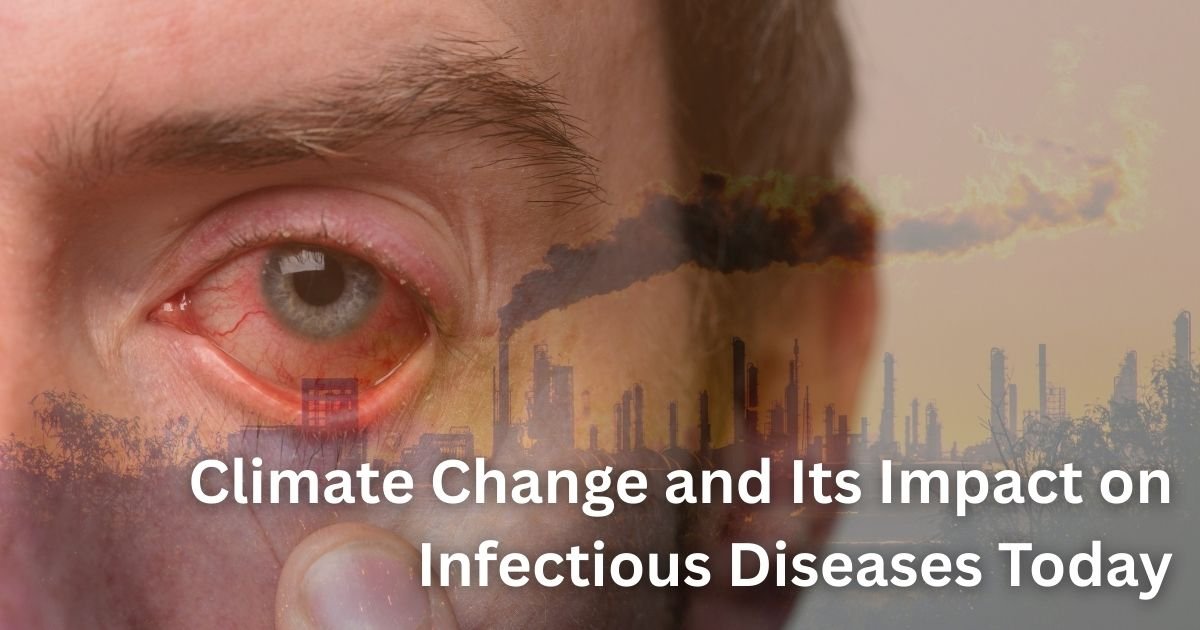
Climate change is no longer a distant environmental concern—it is one of the greatest public health challenges of our time.
Beyond the rising sea levels, melting glaciers, and record-breaking heat waves, climate change is reshaping the very landscape in which
infectious diseases emerge, spread, and persist.
From vector-borne diseases like malaria and dengue to water-borne infections and zoonotic outbreaks, the fingerprints of climate
change are evident.
In today’s interconnected world, this intersection of climate change and infectious diseases demands urgent attention.
The Climate–Disease Nexus
The relationship between climate and health is not new.
Historically, outbreaks of malaria, cholera, and plague were tied to ecological shifts. However, the scale and speed of climate-driven changes in the 21st century are unprecedented.
The mechanisms through which climate change affects infectious diseases include:
– Rising temperatures: Warmer climates accelerate the breeding and biting rates of vectors like mosquitoes and ticks.
– Changing rainfall patterns: Intense rainfall increases water-borne diseases, while droughts force humans and animals into closer contact, facilitating zoonotic spillovers.
– Extreme weather events: Floods, cyclones, and heat waves disrupt sanitation and healthcare systems, creating fertile ground for outbreaks.
– Ecosystem disruption: Deforestation and habitat loss alter the habitats of disease vectors and reservoir animals.
These factors combine to redraw the global map of infectious diseases.
Vector-Borne Diseases on the Rise Mosquito-Borne Illnesses
Perhaps the most striking example is the global expansion of mosquito-borne diseases.
Aedes aegypti and Aedes albopictus, the primary vectors for dengue, chikungunya, and Zika, are thriving in new regions due to warmer climates and altered rainfall.
Once confined to tropical zones, dengue is now reported in temperate regions, including southern Europe and parts of the United States.
The World Health Organization (WHO) estimates that nearly half of the world’s population is now at risk of dengue.
Similarly, malaria transmission is shifting. Highland areas in Africa and South America, once too cool for the Anopheles mosquito, are witnessing outbreaks as average temperatures rise.
This threatens to undo decades of progress in malaria control.
Tick-Borne Diseases
Ticks, which spread Lyme disease, tick-borne encephalitis, and Crimean-Congo hemorrhagic fever, are also expanding their geographic range.
Warmer winters and extended summers allow ticks to remain active longer, increasing transmission opportunities.
Water-Borne and Food-Borne Infections
– Cholera and Diarrheal Diseases
Rising sea surface temperatures and altered precipitation patterns create ideal conditions for Vibrio cholerae, the bacterium causing cholera.
Outbreaks are increasingly reported after floods and cyclones, when safe drinking water is compromised.
Beyond cholera, diarrheal diseases due to E. coli and Rotavirus surge after extreme weather events, especially in low-income regions with fragile sanitation systems.
– Algal Blooms and Seafood Contamination
Warmer oceans encourage harmful algal blooms that release toxins into water systems, contaminating fish and shellfish.
This has direct consequences for human health, leading to food-borne illnesses and economic losses in fisheries.
– Zoonotic Spillovers and Emerging Infections
Another worrying trend is the rise of zoonotic diseases—illnesses that jump from animals to humans.
Climate change, through deforestation, habitat loss, and agricultural expansion, forces humans and wildlife into closer contact.
This increases the risk of viral spillovers.
Nipah virus outbreaks in South Asia are linked to bats encroaching into human settlements due to changing fruiting patterns of trees.
Ebola outbreaks have been tied to shifts in animal habitats and hunting practices.
The COVID-19 pandemic, while multifactorial in origin, highlights how environmental disruption facilitates global health crises.
As temperatures rise, the geographical range of reservoir species (like bats and rodents) also expands, carrying pathogens to new ecosystems.
Antimicrobial Resistance and Climate Change
Climate change indirectly accelerates antimicrobial resistance (AMR)—a looming public health crisis.
Floods and heat waves stress healthcare systems, often leading to inappropriate antibiotic use during outbreaks.
Rising temperatures also enhance bacterial gene exchange in the environment, potentially increasing resistance.
Thus, climate change not only fuels the spread of infections but also limits our ability to treat them.
Vulnerable Populations at Greater Risk
While infectious diseases linked to climate change are a global threat, not all populations are equally vulnerable.
Low- and middle-income countries with weaker healthcare systems face the brunt of outbreaks.
Children, elderly, and immunocompromised individuals are at higher risk of severe disease.
Urban slums and refugee camps, often lacking clean water and sanitation, become epicenters of climate-driven infections.
This disparity underscores the urgent need for equity-focused climate and health policies.
The Indian Scenario: A Case Study
India exemplifies the climate–disease connection.
Rising temperatures and erratic monsoons have led to recurrent dengue and chikungunya outbreaks across states.
Flood prone regions like Bihar and Assam see repeated cholera and leptospirosis outbreaks after heavy rains.
Meanwhile, deforestation in the Western Ghats has raised concerns about emerging zoonotic diseases.
With its dense population, rapid urbanization, and variable climate, India is highly vulnerable to the infectious disease impacts of climate change.
Strategies to Address the Crisis
Tackling this dual threat requires integrated approaches:
1. Strengthening Surveillance
Global and regional disease surveillance systems must integrate climate data with epidemiological monitoring. Predictive modeling can help anticipate outbreaks and guide targeted interventions.
2. Vector Control and Sanitation
Investments in vector control, urban sanitation, and clean water supply are critical. Innovative approaches like Wolbachia-infected mosquitoes and genetic engineering show promise in reducing vector populations.
3. Healthcare System Resilience
Health systems must be climate-resilient—capable of functioning during floods, heat waves, and other disasters. Stockpiling essential medicines, ensuring laboratory capacity, and training healthcare workers are key.
4. Research and Policy
More research is needed on climate-disease links, especially in vulnerable regions.
Policymakers must integrate infectious disease prevention into climate adaptation strategies.
5. Public Awareness and Behavior Change
Community education on safe water, hygiene, and vector control empowers people to protect themselves. Social media and digital platforms can amplify these messages effectively.
Looking Ahead: A Shared Responsibility
The challenge of climate change and infectious diseases is global, but the solutions must be both local and international.
No single country can address this alone. Cross-border collaborations, data sharing, and global health funding are vital.
The COVID-19 pandemic has taught us that infectious diseases recognize no borders; climate change amplifies this reality.
Conclusion:
Climate change is rewriting the epidemiology of infectious diseases before our eyes.
The spread of dengue to temperate zones, the rise In cholera after floods, and the looming threat of zoonotic spillovers are not isolated events—they are the new normal in a warming world.
Addressing this requires urgent, coordinated action that bridges climate science, public health, and community resilience.
In the current era, climate change is not just an environmental issue; it is an infectious disease issue.
Protecting our planet and mitigating climate change is, quite literally, protecting human health.